How Light Pollution Changes What We See in the Night Sky
Light pollution changes what we see in the night sky by blocking starlight before it reaches our eyes. The problem starts when cities pump artificial light upward into the atmosphere, where it scatters and creates a bright haze overhead. This washes out dim galaxies, nebulae, and even the Milky Way from view.
Light pollution astronomy studies this growing problem. And frankly, most of us don’t even realise how much we’re missing. Where you might see thousands of stars from truly dark locations, most Australian suburbs now reveal only 50.
So what can you do about it? This guide explains why cities block celestial objects, what you can still observe from urban areas, and where to find dark skies across Australia. Look up tonight.
How Light Pollution Affects Night Sky Visibility
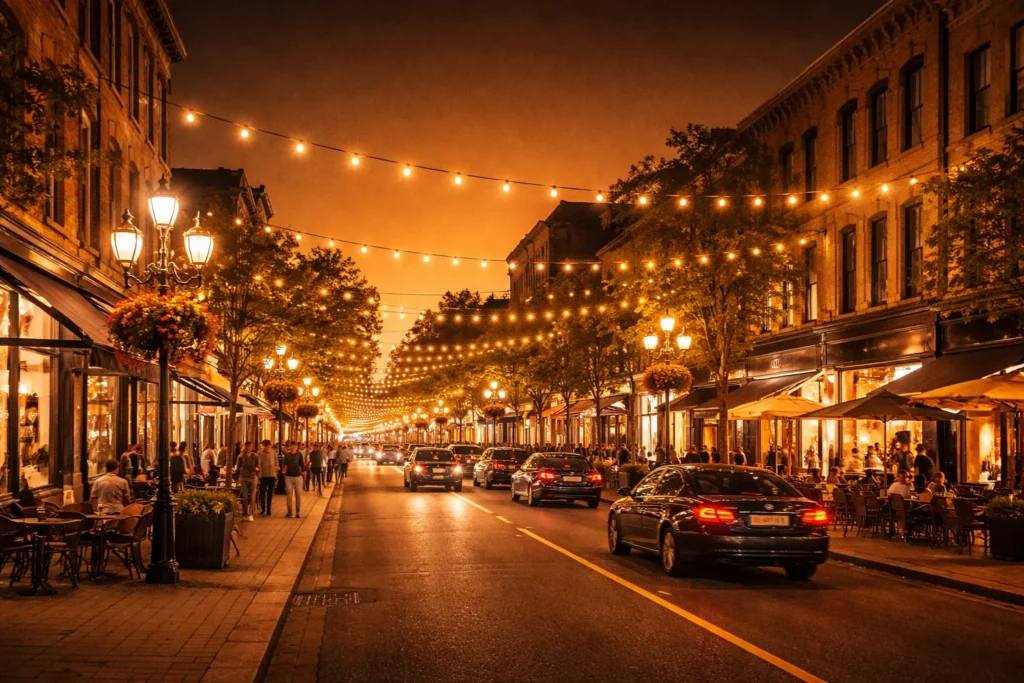
Light pollution affects night sky visibility by creating a glowing barrier between you and the stars overhead. Artificial light from streets, buildings, and outdoor areas scatters through Earth’s atmosphere (and yes, we’ve watched entire constellations vanish as new developments go up).
When this light bounces off air molecules, it produces sky glow that overpowers faint starlight. As a result, fewer stars are visible to your eyes. Here’s what you’re missing.
The Bortle Scale Shows What You’re Missing
The Bortle Scale measures darkness from 1 (pristine dark skies) to 9 (inner city light pollution). So, Class 1 skies reveal over 5,000 stars, while Class 9 shows barely 50. What does that mean exactly? Well, you’re seeing less than 1% of what’s truly up there.
Our observers found that most Australian capitals sit at Class 7-8, blocking the Milky Way entirely from view.
Why Bright Cities Block Faint Celestial Objects
Sky glow overpowers faint starlight from distant galaxies and nebulae completely. In fact, city lights pump out light that’s 100 times brighter than the Milky Way’s natural glow.
Our tests from suburban Brisbane showed Jupiter’s moons clearly through 10×50 binoculars, even with nearby streetlights on. But fainter deep-sky objects like the Andromeda Galaxy disappeared under the same conditions.
Once you understand these effects, the next question stands: what does light pollution cost us other than missing stars?
Light Pollution Astronomy: Beyond Just Missing Stars
Light pollution disrupts wildlife, throws off human health, and damages ecosystems in ways most people overlook. Studies show 99% of Europeans and Americans now live under light-polluted skies. Let’s discuss the issue in detail:
- Nocturnal Species Lose Their Way: Animals depend on dark conditions for hunting and moving through the wild. Artificial light throws off these behaviours completely. What’s worse, sea turtle hatchlings end up heading toward streetlights instead of the ocean (we’re talking millions of birds crashing into lit buildings during migration).
- Insects Drop from Exhaustion: Moths circle outdoor lighting until they collapse, disrupting pollination patterns other species rely on. When outdoor light levels eliminate the natural day-night cycle, wildlife populations decline fast across entire regions.
- Your Sleep Takes a Hit: Believe it or not, your sleep problems might trace back to that streetlight outside your window. Bright nights suppress melatonin. It’s the hormone your body uses to regulate sleep and circadian rhythms.
- The Long-Term Health Cost: Humans evolved under naturally dark skies for millennia, so artificial light at night throws off biological processes that still need darkness. This disruption affects sleep quality, metabolism, and mood regulation in ways that accumulate over the years.
Protecting dark skies helps wildlife, human health, and stargazers alike, which makes finding genuinely dark locations even more important now.
Finding Dark Skies: Where to Escape the Glow
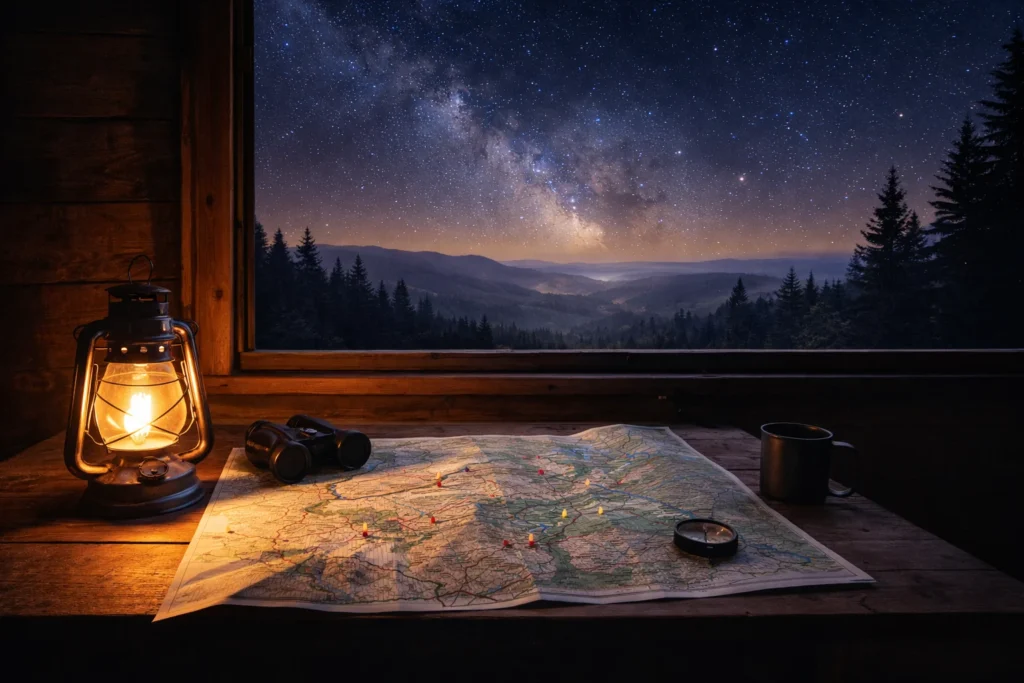
Most Australians live within a two-hour drive of Bortle Class 3-4 dark skies where the Milky Way appears clearly overhead. You’ll find these spots in remote areas away from city lights, at certified dark sky parks, or even in rural locations between major urban centres.
Here’s how to locate them.
How Dark Sky Maps Work
Free tools like Light Pollution Map show darkness levels across Australia using colour-coded zones. For example, dark blue and grey areas indicate Bortle Class 3-4 skies, which means you’ll see the Milky Way clearly stretching overhead.
The great thing about these tools is that they update in real time based on satellite data. So you can plan trips around current conditions and avoid cloudy nights.
Australia’s Certified International Dark Sky Places
Warrumbungle National Park earned certification as Australia’s first International Dark Sky Park from DarkSky International. These protected sites enforce dark sky-friendly legislation that limits outdoor lighting and preserves natural darkness (seriously, the difference hits you the moment you arrive).
River Murray Dark Sky Reserve takes this protection even further, spanning three states and offering some of the continent’s clearest views of celestial objects overhead.
What Makes Any Location Good for Stargazing
Look for spots away from street lights with clear, unobstructed views toward the horizon in all directions. Elevation helps too. Higher locations reduce atmospheric interference, which improves clarity when you’re viewing faint galaxies and nebulae through telescopes.
Before heading out, we recommend checking weather forecasts and bringing red-filtered torches to preserve your night vision in the dark.
Once you’ve found your dark sky site, you’ll want to know what to look for overhead.
What Urban Stargazers Can Still See and Do
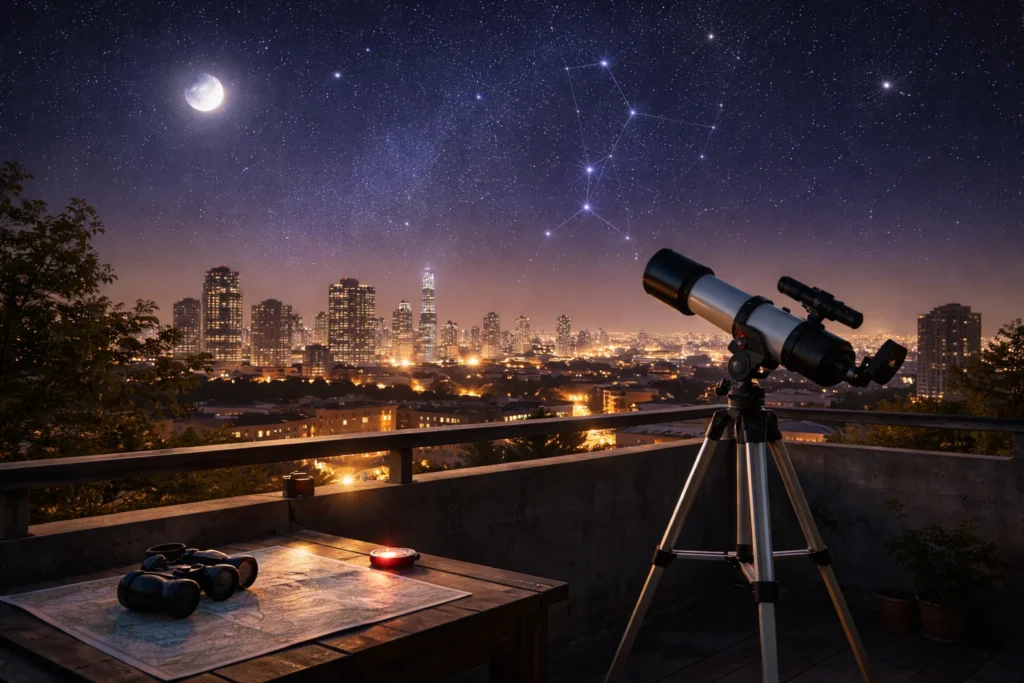
Urban stargazers can still observe planets, the Moon, bright stars, and constellations even under Bortle Class 8 conditions. Though light pollution blocks faint deep-sky objects, the brightest celestial targets shine through city skyglow without any trouble.
Let’s look at what shines through and how you can see it better.
- Venus and Jupiter: These two planets shine brightly enough to cut through heavy light pollution. Basically, this exact characteristic makes them perfect first targets. Venus appears near sunrise or sunset as the brightest object besides the Moon. Meanwhile, Jupiter follows close behind as a steady golden point that never twinkles.
- The Moon Reveals Incredible Detail: Lunar craters and mountain ranges appear clearly through binoculars from urban balconies. We’ve spent countless nights observing from inner-city balconies, and Saturn’s rings still appear through a basic telescope at Bortle 8. This proves you don’t need perfect darkness for planetary viewing.
- Bright Constellations: Orion, Crux, and Scorpius remain visible from suburbs throughout the year. Their bright stars form patterns you can trace even with moderate street lights nearby, which makes them ideal starting points for learning the night sky.
- Simple Steps Improve Urban Views: Let your eyes adapt 20-30 minutes in darkness first, then shield yourself from direct street lights using buildings or trees as barriers. You can seek out apps like Stellarium. They help identify overhead planets and track when they reach peak brightness for viewing.
These techniques help you observe from urban areas, but the view doesn’t compare to what genuinely dark skies offer. Now let’s see what you’ve been missing all along.
The Stars Are Still There, Waiting for You
Light pollution washes out thousands of stars across Australian cities each night. The problem grows as urban areas expand, but solutions exist. Visit dark sky sites, learn what remains visible from your location, and advocate for better outdoor lighting practices.
This guide showed you how artificial light scatters through Earth’s atmosphere to create sky glow, then walked you through the Bortle Scale. You also discovered where certified dark sky parks sit across Australia and which celestial objects shine through city lights.
Step outside tonight and reconnect with the stars overhead. Our team at the Star Hawks Blog takes you through every practical tip you need to observe the night sky from anywhere in Australia. The universe is waiting.